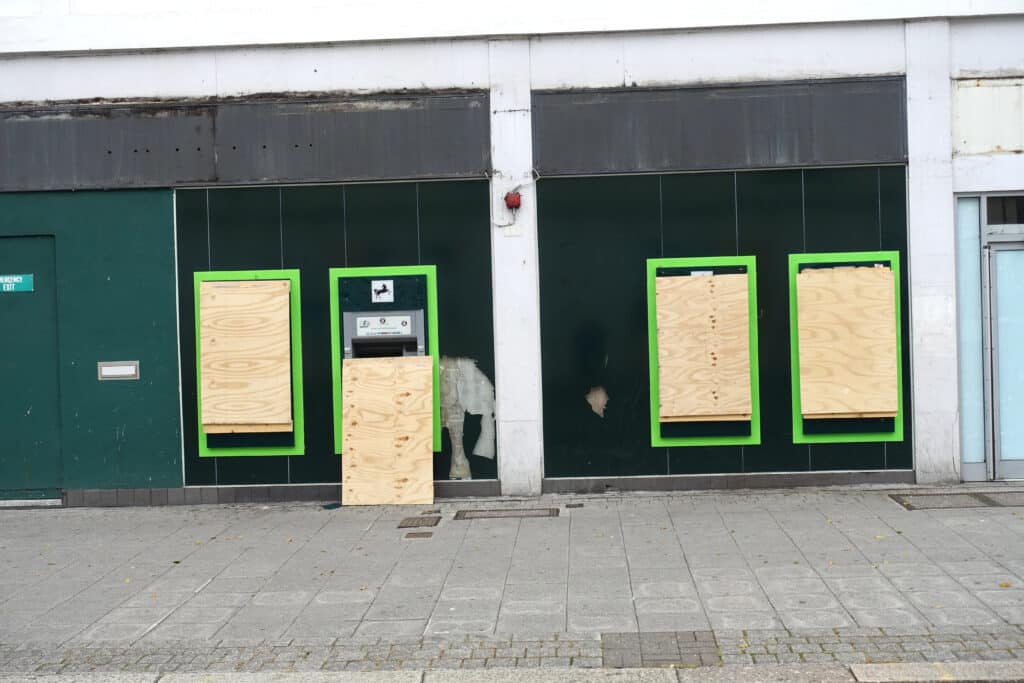

The region only has 248 branches and a population of 5.6 million people, which works out to around four branches available for every 100,000 people, according to a Which? study.
This means every bank customer from Yorkshire and the Humber shares its branch with 22,557 other account holders.
Since January 2015, two-thirds of the branches in the region have closed. Before then, 728 branches had their doors open to customers living in big cities like Leeds, Bradford and Sheffield, with the equivalent of 13 branches for every 100,000 people.
However, the decrease is an issue that’s hit the whole of the UK, with 6,161 branches closing down since 2015 – three-fifths of all the banks in the country.
While Yorkshire and the Humber had the lowest ratio of bank branches, the South East has actually lost the most branches, with 856 providers closing since 2015.

Click here to view our Sponsored Content Hub
London had the second-largest number of closures with 804, but both areas had bigger populations compared to the rest of the UK.
Yorkshire and the Humber has around five-and-a-half million residents, while its Southern counterparts of London and the South East both have a population of around nine million.
In the Northern region, the major lenders to close the most branches since January 2015 are Barclays, HSBC and NatWest, closing 92, 73 and 69 locations respectively.
Closures of banks by major lenders will continue into the new year, too, as Lloyds Banking Group announced it will close 55 branches for customers of its Lloyds, Halifax and Bank of Scotland network from 2025.
The changes have come as the popularity of mobile and online banking has accelerated – in Lloyds’ case, almost 20 million customers are now using its app.
Banking hubs over branches
To appease the shift of banking on your phone, banking hubs are now dotted around the UK – in May, the 50th location opened in Jedburgh, which is on the Scottish Borders.
These hubs provide a space operated by the Post Office that gives customers the chance to go through basic banking requests, including the withdrawal and deposit of cash, paying bills and other routine transactions like checking your balance.
Every hub has a ‘community banker’ who offers an answer to more complex queries. The major banks provide expert help on a rotational basis.
‘This is a nationwide problem’
Sam Richardson, deputy editor of Which? Money, said: “Bank branch closures can have severe impacts on local communities, including on those who still want to use cash. New rules to protect free access to cash have been hard won and should make banks think twice about shutting branches without adequate replacements.
“While Yorkshire and the Humber may hold the dubious record for the worst branch access, this is a nationwide problem. Banking hubs will play a key role in replacing shuttered branches, but their roll-out remains far too slow for consumers to feel their benefits.”
Richardson added: “The Government must hold banks’ feet to the fire to ensure the commitments they’ve made to set up 350 hubs by 2029 are met – and should be prepared to review the target upwards if necessary.”